
Carnegie

There are some promising ingredients. The Masons’ Hall is almost too-perfectly suited to the period, with ornate panelling and deep alcoves that readily become the apartments and offices of Carnegie’s world. The staging, however, rarely makes much use of them. AI-generated backdrops are projected onto an awkward presentation screen beside the stage, while modern set pieces sit uncomfortably aside the period surroundings.
The uncertainty continues in the blocking. Actors not in use stand not quite knowing where to face, as though waiting for their next cue. This is made more awkward by the fact that there are as many people on stage as in the audience. Despite this, the large ensemble never generates enough energy to bring the story to life
The music does little to change that. Much of it comes from MIDI tracks that can sound like a bad karaoke machine, while the singing often feels poorly rehearsed. “Sarsaparilla”, when Carnegie first arrives in New York, is catchy enough, but adds little to the narrative. A brief burst of bagpipes at the death of Carnegie’s father, and some accordion later on, provide a welcome change of texture. But too often there are points where the sound mixing obscures the dialogue, particularly in the epilogue where Carnegie (Luis Garrow) fights against the music and is never quite heard.
Carnegie’s life is crammed in almost event by event. Unsurprisingly, this accumulation never quite becomes a narrative. Instead we are left with little sense of the man beyond the facts of his life, with characters around him drawn in cliche and broad strokes like the cartoonish reporter who frames the narrative.
The show feels increasingly like a two-hour telling of a life rather than a play that should bring a person to life. By the end, it felt like a dog-eared and dusty biography that really should have been left on the shelf.
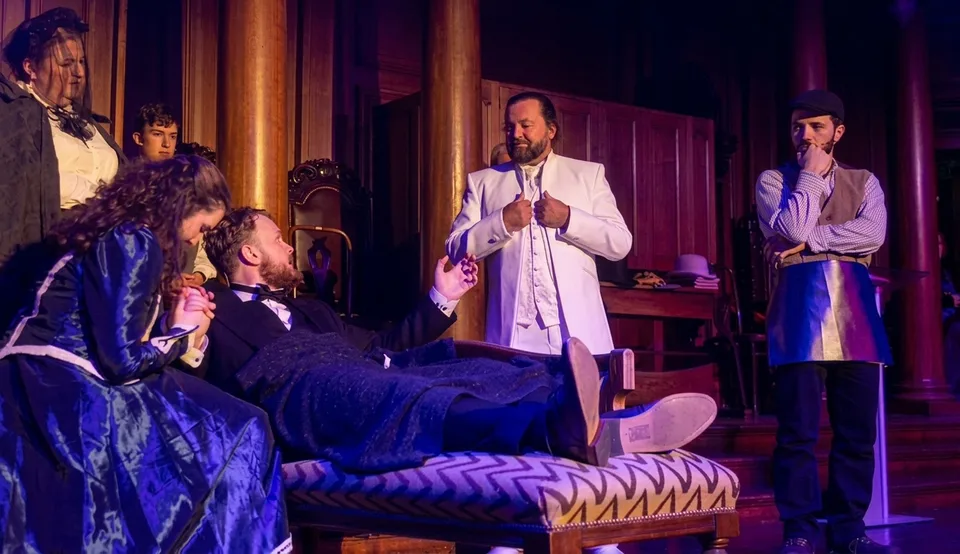
Carnegie by Edinburgh Little Theatre. Credit Thomas Haywood.
About the Show
Ran from 7–30 August as part of Fringe 26.